
Architectural Fragility Beneath Predictive Care


Personalization amplifies whatever infrastructure it sits on. Build on fragmentation, and you scale fragmentation. Hyper-personalized healthcare is often framed as a competitive advantage. From a systems engineering perspective, it acts as a stress test. Predictive AI does not solve infrastructure problems. It exposes them.
Longitudinal patient state as architectural bedrock
Healthcare data is inherently multi-modal and asynchronous. Clinical encounters are episodic. Remote monitoring is continuous. Claims data is batch-processed. Patient-reported outcomes are irregular. Treating any single source as the system of record creates blind spots that compound over time.
Effective personalization in healthcare AI depends on a longitudinal patient state model that integrates structured EHR records, real-time biometric data, claims and eligibility signals, and behavioral engagement metrics. All data must resolve to a single patient identity, align across time, and normalize across schemas.
"Without longitudinal coherence, predictive outputs become probabilistic approximations of incomplete state. Architecture does not support truth. It defines it."
A robust model is version-aware. Patient state evolves continuously. Systems that cannot represent change over time cannot reason about trajectory. Trajectory is the foundation of proactive care.
Feature engineering as a production discipline
Many personalization initiatives fail outside the model layer. Feature engineering is often treated as experimentation. In production systems, it must operate as infrastructure.
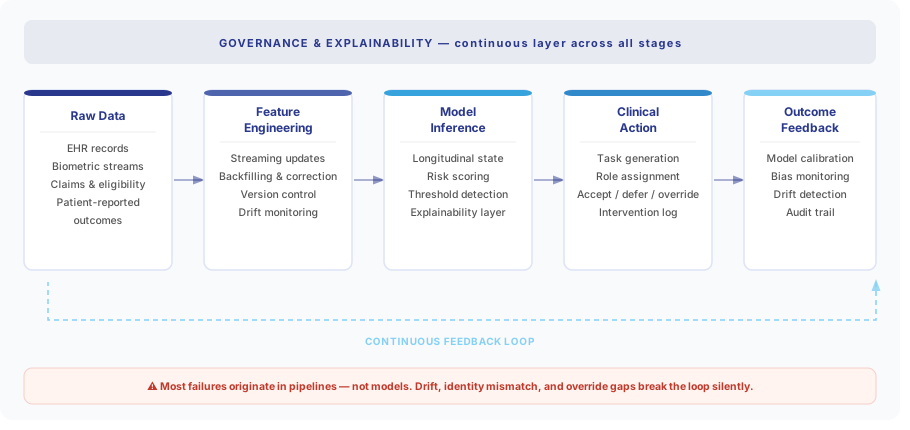
A resilient feature layer supports:
- Real-time streaming updates.
- Historical backfilling and correction.
- Version control across feature definitions.
- Drift monitoring between training and production.
- Validation across population segments.
A mature healthcare data platform separates core layers:
- Raw storage.
- Transform pipelines.
- Feature store.
- Inference services.
- Orchestration.
Coupling raw storage directly to inference introduces systemic fragility. Decoupling these layers enables controlled evolution. Each component can change without cascading failure. This is a prerequisite for safe system evolution.
Binding prediction to clinical workflow
A prediction without an execution pathway is advisory. In healthcare, advisory systems distribute variability rather than reduce it. A deterioration risk score that surfaces in a dashboard but triggers no action creates the illusion of intelligence without operational impact.
When a prediction crosses a defined threshold, the system should:
- Generate a task entity linked to the prediction event.
- Assign responsibility based on role and availability.
- Log acceptance, deferral, or override decisions with context.
- Record the timing and nature of clinical interventions.
- Feed outcomes back into model evaluation and calibration.
Without this closed loop, predictive systems evolve in isolation while care delivery remains unchanged. This is where most AI in healthcare initiatives fail. Not in prediction quality, but in operational integration.
Bias monitoring and explainability at scale
As systems become adaptive, governance must scale with them. Explainability must exist at inference time, not as a post-hoc compliance layer.
A production-grade system includes:
- Explainability interfaces embedded in model serving.
- Continuous demographic performance monitoring.
- Immutable logs of threshold and parameter changes.
- Version-controlled deployment pipelines with rollback capability.
A system that cannot be audited cannot be trusted. In healthcare, lack of auditability introduces clinical and regulatory risk that no accuracy metric can offset.
Where personalization systems break
At Glazed, we consistently see this pattern in production healthcare systems — most failures originate in pipelines, not models. Common breakdowns include:
- Feature drift between training and live environments.
- Amplification of population bias through adaptive feedback loops.
- Inconsistent identity resolution across data sources.
- Latency mismatches between ingestion pipelines.
- Manual overrides that bypass audit trails.
"These failures do not emerge from model mathematics. They emerge from system design. Personalization exposes entropy faster than any other capability because it operates across every layer simultaneously."
Before scaling personalization, technical leadership should be able to answer five questions with confidence:
Architecture readiness diagnostic
- Is longitudinal patient state explicitly modeled rather than inferred from siloed systems?
- Are feature definitions centralized, version-controlled, and monitored for drift?
- Can any personalized decision be reconstructed end-to-end including inputs, model version, output, and resulting action?
- Is bias monitoring continuous and segmented across demographic populations?
- Are intervention workflows deterministic rather than dependent on individual discretion?
Conclusion
Proactive care depends on operational maturity. Trust depends on infrastructure discipline. Personalization requires both, aligned through coherent system design.
Predictive AI scales insight. It surfaces patterns across populations that no individual clinician could detect manually. Insight without structure becomes noise. Personalization without architecture becomes fragility with a sophisticated interface.
In digital health, intelligence compounds when infrastructure holds.
The question is not whether your AI works. It is whether your infrastructure is ready for it — or silently working against it.
At Glazed, we design healthcare systems where AI is supported by the architecture required to create real operational impact.

Thanks for reading. If you enjoyed our content, you can stay up to date by following us on X, Facebook, and LinkedIn 👋.